Grids
- Stella Maze
- Jul 11, 2023
- 3 min read

I love grids. I love how they organize and sort things. I like the way they hold themselves and the way they can be manipulated to be off balance or perfectly stable.
Grids can mean anything and have the power to describe some of the most intangible feelings and sensations.
I made a list of some of my favorite grids. Enjoy.
Agnes Martin: The Islands, 1961

The Islands is a 72 x 72 inch painting of white dots in a grid and a good example of how a grid's pleasing-to-the-eye nature can be used purposefully by artists.
Agnes Martin is an American painter known for creating work that aimed to capture the feeling of a moment rather than representing something physical.
“My paintings are not about what is seen. They are about what is known forever in the mind,” she said once.
The grid in the painting triggers a sensory response of balance and positivity from the viewer- a response that also comes from real experiences people have.
The imperfect symmetry of the painting mimics the feeling of a real moment, the moments that exist all the time in human consciousness like having a conversation with a loved one that relieves a tightness in your chest.
The painting's ability to describe real moments with such a simplistic visual, in my opinion, is so cool.
Piet Mondrian: Broadway Boogie-Woogie, 1942

This piece has a clear musicality which I love. Grids can create a feeling of literal rhythm.
To me this painting feels like a bright and funky rhythm, a group of friends late at night who can’t stop laughing, an intricate hopscotch crisply executed by a kid on the way to school.
Broadway Boogie-Woogie was apparently Mondrian’s last painting before he died but throughout his career he tended to stick to using primary colors plus black and white.
Keeping to this palate and almost exclusively working in perpendicular lines, Mondrian aimed to reach the foundation of things, the truth.
The primary colors, black, white and the perpendicular lines capture theoretically all 2-D visual possibility. Everything that could exist in visual art is in Mondrian’s paintings just at its rawest form. It's like a dictionary of art.
This piece in particular is a little different from most of Mondrian’s work. For example, it has a name and a more narrow focus. But I chose it because it’s one of my favorite examples of how grids can distill a specific feeling.
Massimo Vignelli: Unigrid system, 1977+

Grids are also a tool for creation.
Vignelli was an Italian designer who helped create the unigrid system. It became one of the most efficient options in the late 20th century for designers and cartographers to design book covers, maps, brochures, etc.
The grid template was helpful for designers because it allowed for flexibility and creativity but still provided a clear system for the placement of design elements.
I thought the unigrid was a good example of how purely useful grids were and are. Grids are behind everything!!!!
I also like the way the unigrid templates look on their own.
Josef Müller-Brockmann: Grid Systems in Graphic Design, 1981
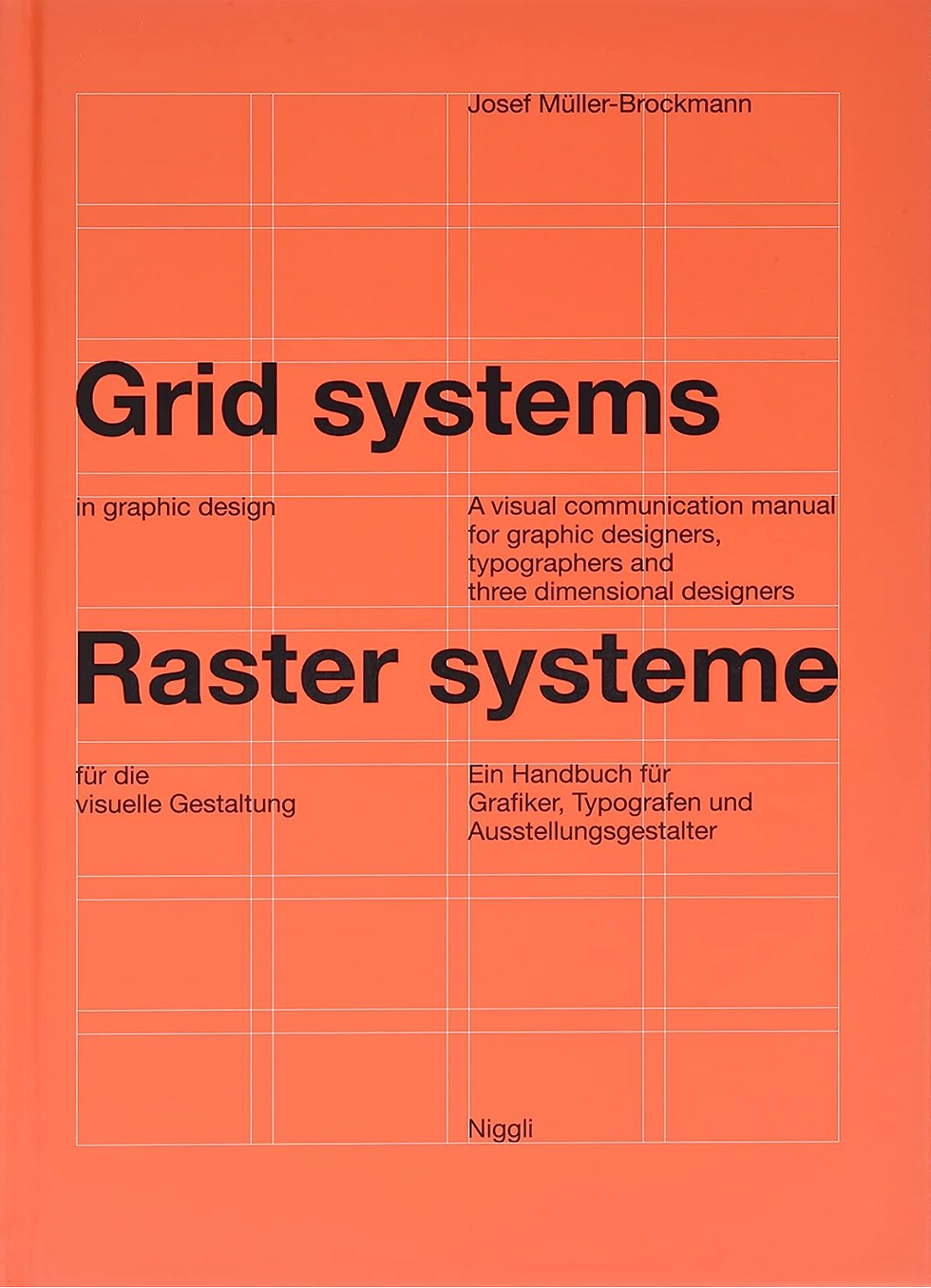
Josef Müller-Brockmann and a group of other Swiss designers created a handbook in 1981 about how to use grid systems.
This particular copy of the handbook is printed in both Dutch and English.
It was a comprehensive (for the time) set of directions for organizing a set of elements on a surface.
The handbook contains detailed directions for how to use a wide variety of grid types for a wide variety of design objectives.
I just love the orangey red and the symmetry of the cover design, obviously an example in itself of grid design.
Grids are everywhere!
And they have so many uses.
They organize, design, signpost. Grids are simplistic, no frills, just what you need.
Grids are used to describe the most foundational version of something- the most truthful version. I love them! #gridsforever
Sources:


Comments